How Custer, South Dakota Got Its Name (It Almost Wasn't Custer)
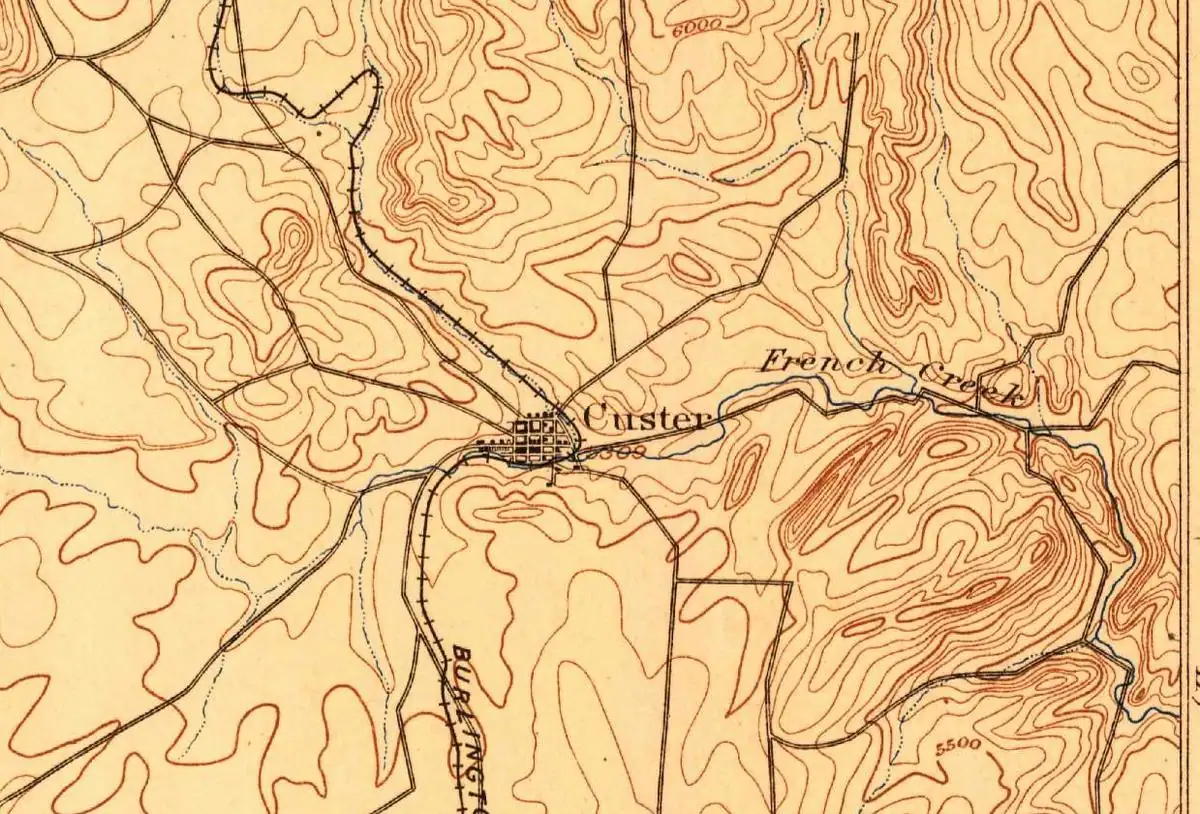
Custer, South Dakota, is named for George Armstrong Custer, whose 1874 expedition found gold nearby. But the miners who settled it in 1875 first called it Stonewall, after the Confederate general Stonewall Jackson. The Union name won out, and the town has been Custer ever since.
Where the name comes from
In 1874, Lt. Col. George A. Custer led an Army expedition into the Black Hills. The National Archives notes that miners came along, and that once gold was found, prospectors were “soon moving onto the Sioux hunting grounds.” Those hills had been recognized as part of the Great Sioux Reservation in the Fort Laramie Treaty of 1868, so the miners were trespassing. According to the town’s chamber of commerce, the Army made repeated attempts to remove them.
The town grew up in the area where that gold had been found, and the USGS record says it was renamed to honor Custer, “who founded gold in the area,” in its words. A 1908 railroad guide to place names says it in four words: “Named for General Custer.” The county around the town carries his name too.
Who named it, and when
The town’s first name came from the other side of the Civil War. The U.S. Geological Survey’s place-name record, quoting an older South Dakota reference, says the settlement was “founded in 1875 and originally named Stonewall, in honor of Confederate General Stonewall Jackson,” and that the name was “later changed to honor General George A Custer.”
That first name tells you something about who was digging for gold in the Black Hills only ten years after the Civil War ended. Not everybody in camp had been on the Union side.
The story locals tell
How did Stonewall become Custer? The local version, as told on the town’s chamber of commerce website, is that the camp held a vote. Confederate veterans wanted Stonewall City, Union veterans wanted Custer City, and there were more Union men in camp, so Custer won “by a few votes.”
It’s a good story, and it fits the facts we do have. But we haven’t found a record from 1875 of the vote itself, so treat it as local tradition rather than documented history.
What happened next
Custer nearly didn’t survive its first year. When word spread in 1876 of richer strikes up north in Deadwood Gulch, the chamber’s history says as many as a thousand people left Custer in a single day. The town recovered, kept the name, and became the seat of Custer County.
One more thing worth knowing: Custer, South Dakota, is not where Custer died. The Battle of the Little Bighorn was fought in Montana in 1876. The town is named for the expedition that came two years earlier.
Sources & further reading
- GNIS feature 1265633 (U.S. Geological Survey). The federal record for Custer. Its history note gives the founding in 1875 as Stonewall and the later change to honor Custer.
- W. H. Stennett, A History of the Origin of the Place Names Connected with the Chicago & North Western and Chicago, St. Paul, Minneapolis & Omaha Railways (1908). A public-domain railroad guide; its Custer County entry says the county seat was “Named for General Custer.”
- National Archives, “Fort Laramie Treaty (1868).” Background on the treaty, the 1874 expedition and the miners who followed.
- Custer Area Chamber of Commerce, “Custer City History” and “Names.” The town’s own telling, including the vote between Stonewall City and Custer City and the 1876 exodus to Deadwood. Useful for local tradition, not as proof.
Spot something wrong? Corrections are noted here with their date, never made silently.