How Deadwood, South Dakota Got Its Name
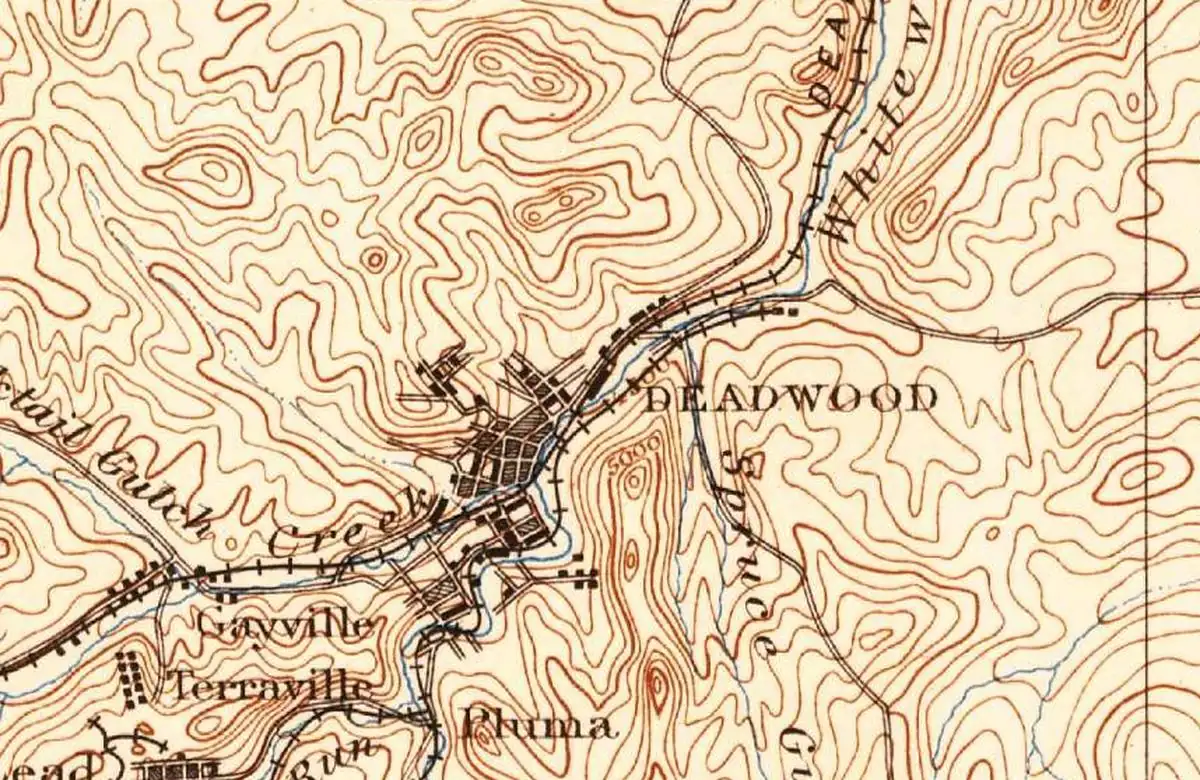
Deadwood, South Dakota, is named after the gulch it sits in, and the gulch got its name from the dead trees the first gold prospectors found there. That’s the whole story, and every source we checked agrees on it.
What makes it interesting is everything around the name: who those prospectors were, where they weren’t supposed to be, and how a canyon full of fallen timber turned into one of the most famous mining towns in the West.
Where the name comes from
Deadwood is a narrow canyon in the northern Black Hills, cut by Whitewood Creek. When the first gold seekers worked their way into it in the 1870s, the gulch was choked with dead timber. A National Park Service history of the town puts it plainly: the first men to find gold there dug above a mat of dead trees that filled the gulch.
The miners called the place Deadwood Gulch, and the camp that grew up along the creek took the same name. A 1908 book on place names along the Chicago & North Western Railway, written by a longtime railroad officer, says the town “was named from Deadwood Gulch, and that was so named because of the many dead trees the first prospectors found in the gulch.” The U.S. Geological Survey’s place-name database quotes that same book.
Who named it, and when
Nobody’s name is attached to it. The records point to the prospectors as a group, which fits the way a mining camp worked: people called the place what it looked like, and the name stuck.
The timing is clearer. The National Park Service nomination for the Deadwood Historic District says prospectors including Frank Bryant and John B. Pearson reached the area in August 1875, and that a townsite called Deadwood was laid out on August 26, 1876. Other references give 1876 as the founding year without a day, so you’ll see slightly different dates depending on where you look.
Why the miners were there at all
Here’s the part the name doesn’t tell you. Under the Fort Laramie Treaty of 1868, the United States recognized the Black Hills as part of the Great Sioux Reservation. Then, in 1874, an Army expedition led by George A. Custer went into the Hills with miners along, gold turned up, and prospectors started pouring onto Sioux land, as the National Archives puts it, “demanding protection from the U.S. Army.”
So the dead trees in that gulch were first seen by people who, legally speaking, weren’t supposed to be there. By the time Deadwood was laid out, the rush was in full swing, and according to Custer’s chamber of commerce, word of the strikes in Deadwood Gulch was emptying older camps like Custer to the south.
Sources & further reading
- GNIS feature 1265180 (U.S. Geological Survey). The federal record for Deadwood. Its history note, which quotes Stennett’s 1908 book, says the town was named from Deadwood Gulch, full of dead timber when prospectors arrived.
- W. H. Stennett, A History of the Origin of the Place Names Connected with the Chicago & North Western and Chicago, St. Paul, Minneapolis & Omaha Railways (1908). A public-domain railroad guide to place names; its Lawrence County entry gives the dead-trees explanation for Deadwood.
- Deadwood Historic District, National Register nomination (National Park Service, 1976). Names the first prospectors, describes the dead timber in the gulch, and dates the townsite to August 26, 1876.
- Encyclopaedia Britannica, “Deadwood.” Confirms the town was named for the dead trees in the canyon and founded during the 1876 gold rush.
- National Archives, “Fort Laramie Treaty (1868).” Background on why the Black Hills were Sioux land when the miners arrived.
- Custer Area Chamber of Commerce, “Custer City History.” The source for the exodus from Custer when news of the Deadwood strikes spread.
Spot something wrong? Corrections are noted here with their date, never made silently.